The Workbench · Ownership
Big Slice / Small Slice (BSSS)
A milestone-based framework for allocating ownership dynamically and transparently in early ventures. It exists to prevent resentment, hidden dilution, and retroactive negotiation when a team is contributing unevenly under high uncertainty.
This is the ownership engine behind the Venture Studio and the Innovation Commons.
The general idea
When working with friends on projects, you always run into the same problem: everyone has hidden expectations about ownership and what it means to be successful. Many of us don’t even know we hold these expectations — they’re based on how we were raised and what we value. They are personal, hidden, and can easily destroy a friendship if the thing becomes successful.
On the flip side is the overthinking that happens from creating shares too early. It costs real money, momentum, and energy to create shares and a vesting schedule. Suddenly that playful idea feels like work, and it kills the joy of creation.
BSSS is a set of rules that act as insurance against the miscommunication that forms when everyone is excited to build something and nobody wants to stop and negotiate how much each person will own — until, too late, it isn’t worth nothing.
Vocabulary
Big Slices
A Big Slice represents a major milestone in the life of a project.
Each Big Slice:
- Consumes a declared percentage of the total 100%
- Is tied to a specific Release Level (RL1–RL10)
- Has a point budget for contribution tracking
- Opens when work begins
- Closes when the Release Level is achieved
Critical rule: once a Big Slice is created, its percentage must never change. Point budgets may increase. Ownership percentages may not.
Small Slices
Contributors earn Small Slices inside a Big Slice. A Small Slice represents a contributor’s proportional share of that Big Slice, calculated as:
(points earned / total points in the Big Slice) × Big Slice percentage
When a Big Slice closes, the ownership earned inside it is locked.
The rules
Rule 1 — Treat ownership as a fixed whole
A project begins as 100% ownership. Think of a pie. Budget out the milestones the project is going to go through, set a percentage for each milestone, and lock that down with your group.
Rule 2 — Track effort from each contributor in each phase
The philosophy is that progress earns ownership, time alone does not.
You can track hours, dubloons, or happy points — it doesn’t really matter. A point system works well because then effort like sales or connections can be trued up against hours; sales, networking, and engineering work very differently and the contributions are not equivalent.
The easiest way to do this is to set up a regular meeting where everyone shows up and says how many points they contributed. The group agrees or debates it, and records the decision in a journal. This turns one giant awkward discussion into lots of little ones.
Rule 3 — At the end of each Big Slice, tally the Small Slices
Ownership is divided into:
- Big Slices — milestone-level allocations
- Small Slices — individual shares earned within a milestone
At the end of each milestone, tally how many points each contributor made and proportionally split the Big Slice they just worked through. Then move on to the next phase.
That ownership is not assigned to people upfront. Instead, it is earned over time as the project progresses through meaningful milestones.
Recommended ownership allocation
The following table is a recommended allocation of ownership across Release Levels. This is not universal law — it is an opinionated default that reflects where risk and value tend to concentrate.
| Release Level | Description | Slice % |
|---|---|---|
| RL1 | Idea | 4% |
| RL2 | Vision | 4% |
| RL3 | Prototype | 4% |
| RL4 | Play Test | 12% |
| RL5 | Release | 16% |
| RL6 | Users | 12% |
| RL7 | Audience | 12% |
| RL8 | Monetized | 12% |
| RL9 | Scalable | 12% |
| RL10 | Stable | 12% |
| Total | 100% |
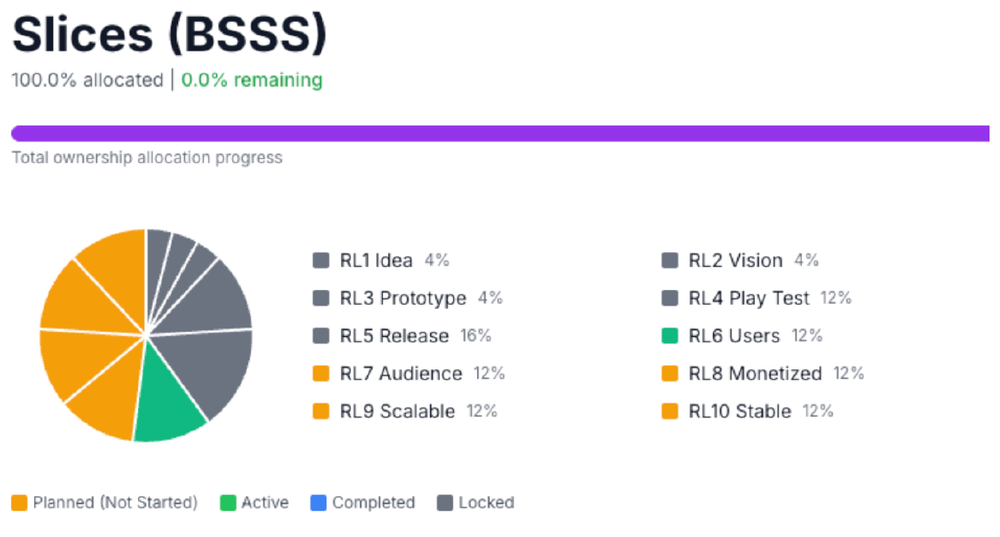
The philosophy behind this allocation:
- Early stages matter, but are highly speculative
- Mid-stage execution carries the highest product risk
- Late stages reward durability, scale, and operational excellence
What this is (and is not)
This system is:
- A contribution accounting model
- A milestone-based ownership framework
- A pre-equity alignment tool
This system is not:
- Legal equity
- A cap table
- A shareholder agreement
It is a bridge between ambiguity and formality. Assuming success, you can transition to something more formal like a cap table and preferred shares. But until then, it can just be a spreadsheet.